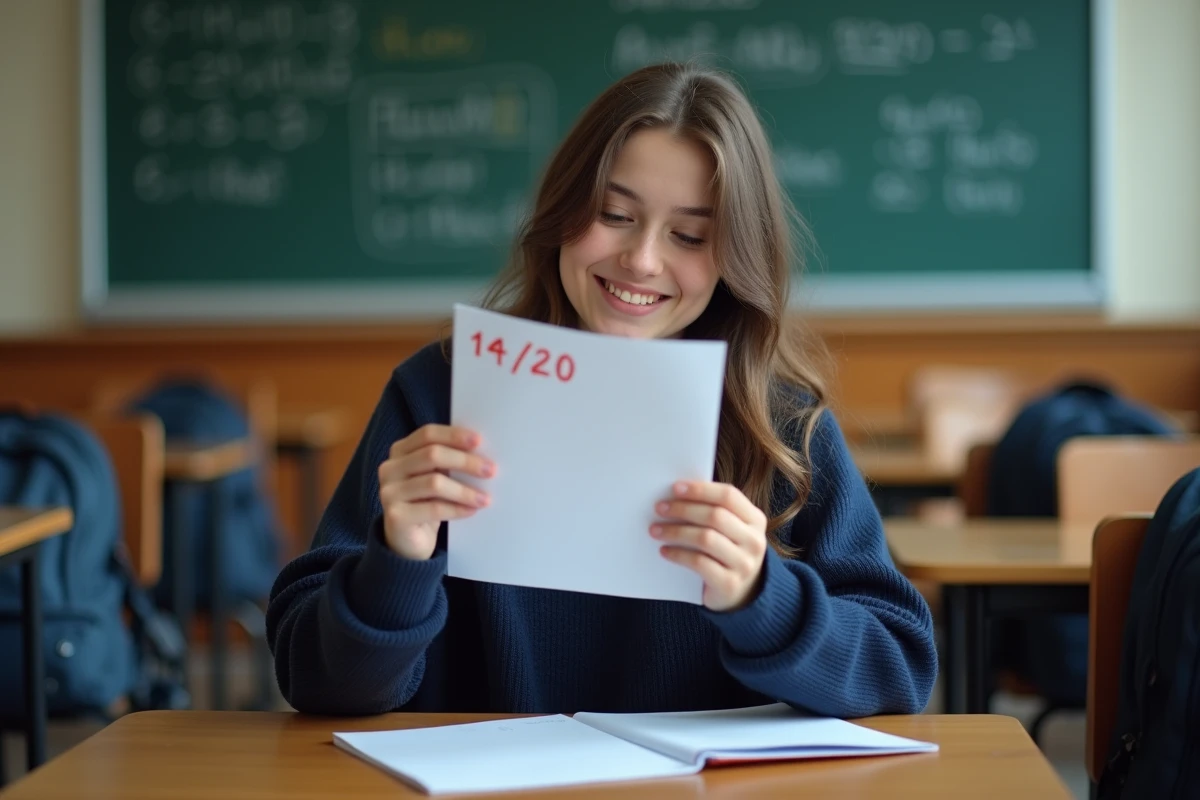
A 14 out of 20 on a paper rarely goes unnoticed. Parents, students, and teachers project different, sometimes contradictory expectations onto it. This grade is above the national average in most subjects, but its real value depends on parameters that the raw number does not convey.
Since the widespread implementation of continuous assessment for the baccalaureate (reforms 2019-2022), the dispersion of grades between institutions has increased according to reports from the Ministry of National Education. A 14/20 in a highly selective high school and a 14/20 in a more lenient institution tell different stories. Understanding the meaning of a 14 out of 20 therefore requires going beyond the simple number on the report card.
Grading scale out of 20 and school effect: why 14 does not always equal 14
The French grading system operates on a scale from 0 to 20, but teachers rarely use the entire scale. In many literary subjects, an 18 or 19 remains exceptional, while in sciences, very high grades appear more frequently on closed-answer exercises.
This first bias is compounded by a second one: the school effect. Two examiners, faced with the same paper, may assign different grades by several points. Docimology, the discipline that studies grading practices, has documented this phenomenon for decades. The grade reflects as much the evaluation context as the student’s level.
In the scales used by certain European institutions, a 14/20 corresponds to the mention “good” (see the scales of IHECS in Belgium, where the range 14-15 is classified as “C – Bien/Good”). This correspondence provides a reference, but it does not take into account the local specificities of each class.

Continuous assessment and grade inflation in high school
The massive introduction of continuous assessment in the calculation of the baccalaureate has changed the game. When the teacher who teaches is also the one who grades for the exam, the boundary between formative and summative assessment becomes blurred.
Institutional reports indicate a trend of rising overall averages since these reforms. This phenomenon, often referred to as grade inflation, does not mean that students are working less. It reflects a change in framework: teachers, aware of the weight of each grade on the Parcoursup file, sometimes adjust their grading scale.
For a student who receives a 14/20 in continuous assessment, the relevant question is not “is this a good grade in absolute terms?” but rather:
- What is the class average on the same assessment? A 14 when the class average is 8 and a 14 when it is 13 do not carry the same weight.
- What is the positioning within the group? The quartiles and deciles on the report card provide more reliable information than the isolated grade.
- Is it a subject with a broad grading scale (philosophy, French) or a narrow grading scale (mathematics, physics)? The margin for improvement varies depending on the case.
Grade of 14/20 and post-baccalaureate orientation: a shifting threshold
In selective pathways (preparatory classes, certain degrees, schools), a 14/20 in high school is increasingly seen as a minimal prerequisite rather than a distinguishing level. Higher education institutions now communicate “success profiles” where expected averages tend to rise.
This shift creates a paradox. A student who consistently scores 14 is objectively positioned at the top of the national ranking but may find themselves in the middle of the pack in the most demanding selection processes.
The conversion to other grading systems sheds light on this ambiguity. In the American GPA system (scale from 0 to 4), a 14/20 in France is generally converted to around 3.0 to 3.3, which is a “B” – respectable, but not outstanding. In Switzerland, where grading ranges from 1 to 6, a 14/20 is approximately equivalent to a 4.5-5, which corresponds to a “good” level without reaching “very good”.

Psychological pressure and performance anxiety above average
Data from the National Observatory of Student Life (OVE, 2023) reveal a counterintuitive finding: students above average often experience more performance anxiety than lasting satisfaction. From around 14/20, the grade becomes less a source of pride than a level to maintain at all costs.
This mechanism is partly explained by the psychological framing of the grade. Research in educational psychology distinguishes two orientations: mastery orientation (learning to understand) and performance orientation (learning to achieve a numerical result). A 14/20 experienced solely as a score to defend fuels the latter orientation, with a risk of burnout.
The problem does not stem from the grade itself but from the lack of context that accompanies it. A report card that displays “14/20” without qualitative commentary leaves the student and their family without a reference to distinguish what is solid from what remains fragile. The grade without qualitative analysis loses much of its pedagogical function.
Reading a 14/20: the criteria that really matter
Interpreting a 14 out of 20 requires cross-referencing several pieces of information that the number alone does not provide:
- The distribution of class grades (average, highest grade, lowest grade) allows for situating performance in its real context.
- The nature of the assessment matters: a 14 on a multiple-choice quiz and a 14 on a reasoned essay do not mobilize the same skills.
- Progress over time is more important than a snapshot. A student moving from 10 to 14 over a term progresses more significantly than a student stable at 14 for two years.
- Written feedback from teachers, when available, remains the most reliable complement to give meaning to the number.
A 14/20 remains, in the French system, a solid grade that places the student in the upper part of the scale. The mention “good” in the baccalaureate starts precisely at this threshold. But reducing a schooling experience to a number is akin to reading a thermometer without looking at the patient: the information exists, but it is simply insufficient on its own to make a diagnosis.