The first half of 2026 reshuffles the cards in several industrial sectors. Between the acceleration of artificial intelligence applied to agriculture, the financial decisions of European public banks on deep tech, and the emergence of new manufacturing processes, the landscape of technological innovation is reshaping at a pace that complicates understanding for industry players.
Additive manufacturing and hybrid processes: what is changing on production lines
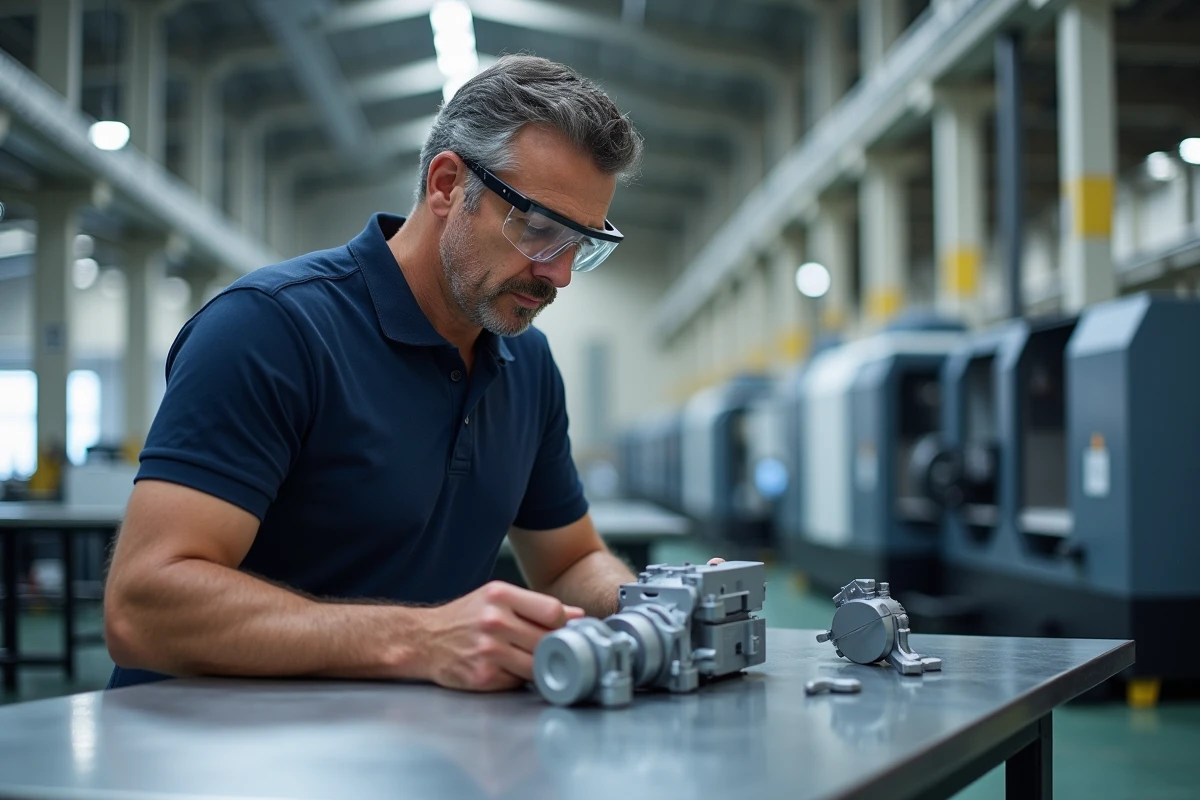
Additive manufacturing is no longer limited to rapid prototyping. Several European manufacturers are now integrating hybrid processes, combining metal 3D printing and conventional machining on the same line. This convergence reduces the number of post-processing steps and shortens the time between design and finished part.
The Polytech 3D exhibition, organized by the Polymeris competitiveness cluster, illustrates this trend. The demonstrations focus on technical polymer materials and high-performance composites, with direct applications in aerospace and medical fields. Field feedback varies on this point: some manufacturers report significant productivity gains, while others highlight the cost of integrating hybrid equipment into workshops designed for subtractive processes.
Recent innovations in manufacturing are regularly documented on the Make World homepage, which aggregates advancements from French and international industrial sectors.
What deserves attention is the issue of skills. Training an operator to run a hybrid machine is not just a matter of adding two separate training programs. Technological universities, such as UTT (University of Technology of Troyes), are developing curricula that intersect materials science, programming, and online quality control.
Artificial intelligence and precision agriculture in Europe
The French Ministry of Agriculture documents in 2026 a rapid spread of precision technologies in major crops: embedded sensors, weeding robots, input management algorithms. The stated goal is twofold: to reduce the use of pesticides and stabilize yields in the face of climate variability.
Germany provides complementary feedback on the acceptance of these tools by farmers. The available data does not allow for a conclusion on a uniform adoption rate, but the signals converge towards faster adoption in larger farms, which are better equipped with connectivity.
Technical limitations still present
AI management relies on massive datasets. In rural areas where network coverage remains uneven, the collection and transfer of real-time data poses a concrete problem. Several pilot projects circumvent this constraint by embedding processing directly on the machines, without relying on the cloud.
The question of agricultural data sovereignty remains open. Who stores yield data, soil composition, and input consumption? American platforms dominate the market for parcel management software, which raises concerns among some European farmers.
European funding for deep tech: the choices of the European Investment Bank
The European Investment Bank (EIB) has been explicitly prioritizing AI, quantum computing, and high-speed connectivity in its funding policy since 2025. Programs dedicated to innovation and human capital accompany this direction, aiming to structure deep tech ecosystems capable of competing with those in the United States and Asia.
A recent market report estimates the global deep tech market at several billion dollars, with expected growth towards the end of the decade. This estimate covers advanced AI, quantum technology, biotechnology, and new materials.
Geographical concentration of investments
The geographical concentration of investments remains a blind spot. In Europe, a few hubs capture the majority of funding:
- Île-de-France and its deep tech incubators, benefiting from a critical mass effect in terms of researchers and venture capital.
- Bavaria and Baden-Württemberg in Germany, supported by a dense industrial fabric and close ties between technical universities and SMEs.
- The Netherlands, where the semiconductor sector (around ASML) nourishes a startup ecosystem in photonics and nano-manufacturing.
Intermediate regions, including in France, struggle to attract the same volumes. Public funding is not sufficient without a local pool of trained talent, which brings us back to the recurring issue of education in science and engineering.

Audio-visual and generative AI: content production at a turning point
The audio-visual sector illustrates a use case where technological innovation directly impacts established business models. The magazine Mediakwest dedicates its issue 66 to the integration of AI in audio-visual production workflows: automatic subtitle generation, assisted editing, and creation of virtual sets.
The time savings are real for repetitive tasks. However, generative AI applied to creation raises unresolved copyright questions in both French and European law. Unions of technicians and creators are calling for a clear legal framework before any widespread adoption.
The line between assistance tool and substitution of human skills remains blurred. Production companies that adopt these tools often do so without consulting technical teams, leading to social tensions documented in the specialized press.
Research and industry in France: still fragile bridges
French public research produces world-class results in several fields related to deep tech. The transfer to industry remains the weak link. Existing mechanisms (SATT, incubators, competitiveness clusters) have accelerated some projects, but the average time between scientific publication and market launch of a product remains long compared to American or Israeli ecosystems.
Technological universities are trying to reduce this delay by integrating entrepreneurship modules into engineering curricula and opening their technological platforms to local SMEs. The rapprochement between laboratories and manufacturing workshops is probably the most concrete lever to accelerate industrial innovation in the territory.
The first half of 2026 confirms an underlying trend: technologies are maturing faster than regulatory frameworks, funding models, and available skills. Europe has solid foundations (research, industrial fabric, public funding), but their assembly remains slower than that of its direct competitors.