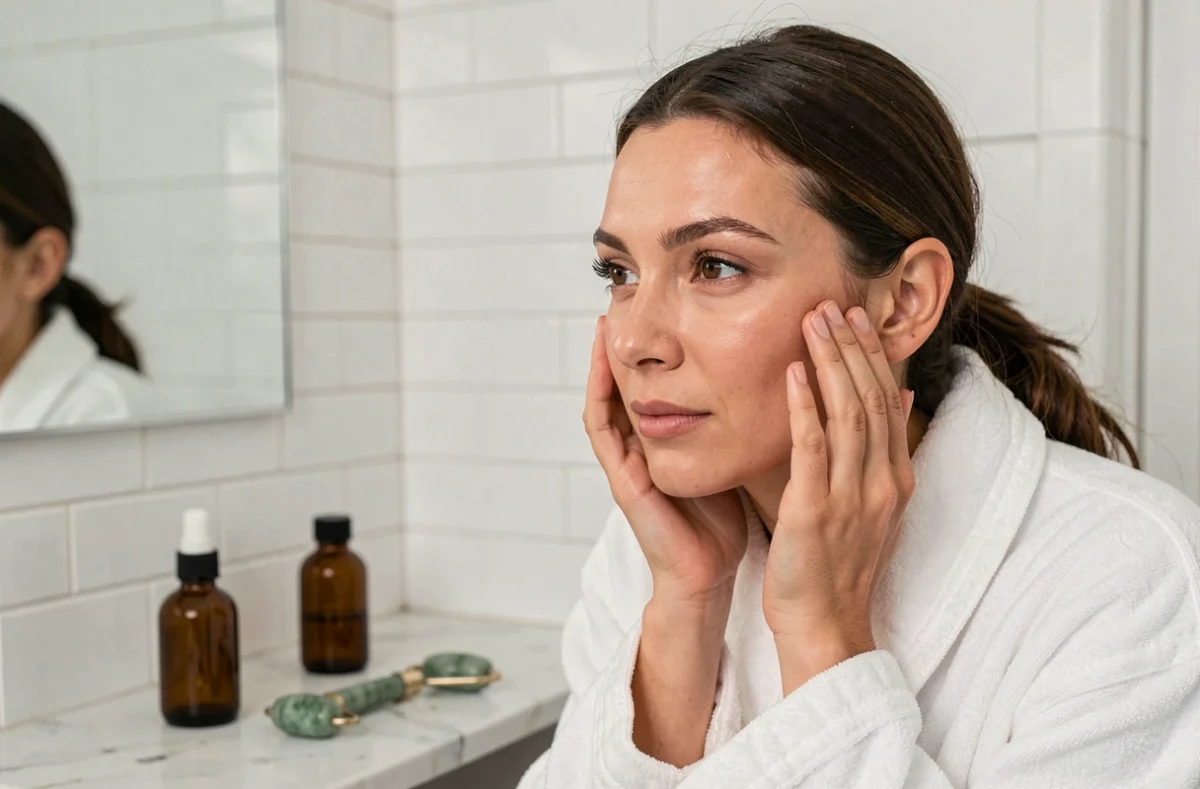
The natural cosmetics market is growing, driven by demand for greater transparency about ingredients. At the same time, the European directive on environmental claims now governs how brands communicate their green promises, without regulating the formulation of the products themselves. In this context, building a natural beauty routine that delivers on its promises means looking beyond the labels and understanding what your skin can actually tolerate.
Natural routines and irritation risks: what plant-based ingredients don’t guarantee
A skincare product made from plants is not automatically gentle. Essential oils, often presented as star ingredients in natural routines, can irritate or sensitize the skin. Some citrus oils are even photosensitizing: applied before sun exposure, they can cause skin reactions that are sometimes severe.
This risk is rarely explained in at-home routines that recommend mixing plant-based ingredients without any usage precautions. A poorly diluted essential oil can cause more harm than a well-formulated synthetic active ingredient. The relevant distinction is not between natural and chemical, but between a product suited to a particular skin type and one that isn’t.
To explore approaches that take these nuances into account, the beauty section on Pulpe de Coton offers useful resources on facial and body care.
Dermatologists recommend introducing just one new product at a time into your routine, then monitoring your skin’s reaction for two to three weeks. This makes it easier to identify the ingredient responsible for any irritation, whether natural or not.

Sun protection in a natural routine: more than just the SPF rating
Sun protection remains the most well-documented way to prevent skin aging and maintain a radiant complexion. European recommendations for sunscreen efficacy cover protection against UVA as well as UVB rays. A high SPF rating alone does not tell you everything about a product’s protection.
Mineral sunscreens (zinc oxide, titanium dioxide), often favored in natural routines, offer broad-spectrum protection. Their drawback: a thick texture and white cast that can discourage regular use. But sunscreen that is applied incorrectly or in insufficient amounts loses much of its effectiveness, whatever its SPF rating.
Morning moisturizer: not always necessary
One point rarely mentioned in six- or eight-step routines: some people with oily skin can skip moisturizer in the morning if their sunscreen provides enough hydration and their skin feels comfortable. Dermatologists cited by Beauté Test confirm this approach.
Dry or sensitive skin, or skin affected by certain conditions, does need dedicated hydration before sunscreen. The right routine is therefore not defined by a fixed number of steps, but by what your skin needs at any given time.
Environmental claims for natural cosmetics: what regulations actually cover
The growing number of labels and claims such as “organic,” “natural” and “clean” on packaging creates an impression of guaranteed quality. The European directive on environmental claims aims to curb greenwashing by regulating how brands communicate. But the directive regulates marketing claims, not product ingredients.
A cosmetic product can boast a high percentage of ingredients of natural origin while still containing preservatives or emulsifiers that irritate some skin types. A label is no substitute for reading the INCI list (the International Nomenclature of Cosmetic Ingredients).
- Checking the INCI list for known allergens, even on a certified organic product, can help prevent reactions in sensitive skin
- Claims such as “paraben-free” or “sulfate-free” don’t tell you what has replaced those ingredients: some substitutes are just as irritating
- A product certified by an independent organization (Cosmos, Natrue) meets stricter standards than one simply labeled “natural,” but this does not guarantee that it will suit every skin type

Building a beauty routine for your skin type: what really matters
The routines most widely shared online follow the same pattern regardless of skin type: cleanser, toner, serum, moisturizer, sunscreen. This sequence isn’t wrong, but it becomes a problem when it encourages people to use more products without a good reason.
The dermatologist-recommended basics come down to three steps: gentle cleansing, hydration as needed, and sun protection in the morning. Everything else (serum, exfoliant, mask) should be added to address specific concerns, not used by default.
Adjusting facial skincare to the season
Skin that absorbs a plant oil well in winter may find it too occlusive in summer. Cleansing needs can also change: summer pollution and perspiration may sometimes call for double cleansing, which isn’t necessary in winter.
- In cold weather, choose richer textures (shea butter, argan oil) to counteract dehydration caused by indoor heating and wind
- In warm weather, simplify your routine with aloe vera or hyaluronic acid products that hydrate without feeling greasy
- Check in with your skin each month rather than sticking to the same routine all year: its needs fluctuate with hormonal cycles, stress and diet
Radiant skin doesn’t depend on how many natural products you layer on your face each morning. It depends on choosing steps that suit your skin type at a given time, using ingredients whose benefits and limitations you understand. A short, well-targeted routine delivers more visible results than a long, generic one.